- This topic is empty.
-
AuthorPosts
-
2026-06-23 at 2:03 pm #65115
When internet service providers plan network infrastructure upgrades, backup power for customer premises equipment often becomes an afterthought—until service interruptions trigger complaint spikes and field support costs escalate. For ISPs managing fiber broadband, DSL networks, or wireless access infrastructure, ensuring uninterrupted connectivity at the subscriber level requires a strategic approach to backup power deployment that balances technical requirements, cost efficiency, and long-term reliability.
Understanding the ISP Backup Power Challenge
Internet Service Providers face a unique operational dilemma. While central office equipment and network core infrastructure typically benefit from sophisticated UPS systems and backup generators, the thousands of routers, ONTs, modems, and gateways deployed at customer premises remain vulnerable to local power disruptions. A single neighborhood power outage can instantly disconnect hundreds of subscribers, generating service tickets, overwhelming call centers, and damaging customer satisfaction metrics.
The challenge extends beyond simple device downtime. Modern broadband services increasingly support critical applications—remote work, telehealth, home security systems, and smart home infrastructure. When customer-side network equipment loses power, the impact cascades across multiple service dimensions. ISPs must field support calls, dispatch technicians for unnecessary troubleshooting (when the root cause is power, not connectivity), and risk subscriber churn in competitive markets where reliability differentiates service providers.
Traditional solutions—recommending consumers purchase retail UPS systems—create inconsistent results. Customers select incompatible products, install them incorrectly, or skip backup power entirely due to cost or complexity. ISPs need a systematic deployment approach that ensures compatibility, simplifies installation, and delivers predictable backup performance across diverse equipment types and deployment scenarios.
Technical Requirements for ISP Backup Power Systems
Effective backup power planning begins with precise technical matching. Unlike generic consumer applications, ISP equipment backup demands careful alignment between power supply characteristics and device specifications. Router backup systems must accommodate actual working current, not just adapter ratings—a critical distinction that prevents field failures when devices draw peak loads during startup or high-traffic periods.
Voltage matching forms the foundation of reliable backup. Most consumer broadband equipment operates at 12V DC, but fiber ONTs, advanced gateways, and wireless CPE devices may require 5V, 9V, 15V, 24V, or 48V configurations. Backup systems must deliver stable output voltage within the device’s acceptable range throughout the entire discharge cycle. Voltage droop under load or during battery depletion can cause spontaneous reboots—defeating the backup system’s purpose.
Current capacity requires equally careful evaluation. Many deployment failures stem from relying solely on power adapter labels rather than measuring actual device consumption. A router with a 2A adapter might draw 0.8A during normal operation but surge to 1.5A during boot sequences or firmware updates. Backup systems undersized for these transient loads fail exactly when subscribers need them most. Shanghai Mylion New Energy Co., Ltd. addresses this through application-specific model selection, matching backup capacity to verified device behavior rather than nameplate ratings.
Connector compatibility eliminates a frequent deployment obstacle. Broadband equipment uses diverse DC barrel connectors, USB-C Power Delivery interfaces, and proprietary connection schemes. Backup systems must physically mate with target devices without adapters or modifications that introduce resistance, connection instability, or installation complexity. For large-scale ISP deployments, MYLION offers connector customization and cable matching to ensure plug-and-play compatibility across equipment fleets.
Runtime targets must balance practical needs against cost constraints. Most ISPs design backup systems for 2-4 hour operation—sufficient for typical residential outages while avoiding the size and expense of extended-duration systems. However, deployment environments matter. Regions with frequent, prolonged outages may justify 6-8 hour configurations, while urban areas with stable grids can optimize for shorter, more frequent interruptions. Battery capacity selection should account for real device power consumption multiplied by target runtime, with appropriate safety margins for battery aging and environmental factors.
Deployment Models for Different ISP Scenarios
Standard Router Backup represents the most common ISP deployment scenario. For mainstream fiber broadband or DSL services, compact 12V DC backup units like MYLION’s MU68, MU26, and MU48 series provide reliable power continuity for routers, modems, and basic gateways. These systems suit ISP programs where subscribers receive standardized equipment, enabling bulk procurement of matched backup units with consistent installation procedures. The compact desktop or wall-mountable form factors accommodate typical customer premises environments without specialized installation requirements.
FTTH Inline Backup addresses space-constrained fiber-to-the-home deployments where traditional desktop UPS units prove impractical. MYLION’s MUJ46 inline design integrates directly into the DC power path between adapter and ONT, minimizing visible footprint and simplifying installation for field technicians. This approach works particularly well for optical network terminals mounted in utility closets, garages, or locations where discrete backup deployment preserves aesthetic considerations while delivering essential power continuity.
High-Power Gateway Backup becomes necessary when ISPs deploy advanced routers, WiFi 6 gateways, or integrated voice/data/video platforms that exceed standard backup unit capacities. Devices consuming 2-3A or more during operation require robust backup systems like MYLION’s MU35 and MU65 high-current models. These applications demand careful load verification before deployment—field failures from undersized backup systems damage subscriber confidence and generate costly truck rolls for equipment replacement.
Multi-Voltage Deployments challenge ISPs managing diverse equipment portfolios. When serving business customers, supporting legacy equipment, or deploying specialized CPE, backup systems must accommodate 24V or 48V requirements alongside standard 12V devices. MYLION’s MU248 series addresses these scenarios with higher-voltage DC backup options, while USB-C PD models like MUC85 support next-generation equipment adopting USB Power Delivery architectures. Strategic inventory management—stocking appropriate backup variants matched to deployed equipment types—prevents deployment delays and ensures technical compatibility across the service portfolio.
OEM and Private Label Programs enable ISPs to reinforce brand identity while controlling backup power quality. Rather than directing subscribers to retail channels, forward-thinking service providers integrate co-branded backup units into equipment packages, installation kits, or premium service tiers. MYLION supports OEM customization including private labeling, customized packaging, documentation integration, and connector matching—allowing ISPs to deliver cohesive subscriber experiences while maintaining supply chain control and quality consistency.
Implementation Considerations for ISP Backup Programs
Successful deployment extends beyond technical product selection to encompass logistics, documentation, training, and support infrastructure. Sample testing should validate compatibility with actual deployed equipment under realistic conditions—verifying startup behavior, runtime performance, connector fit, and installation procedures before committing to volume procurement. This phase identifies potential issues when corrections remain inexpensive rather than discovering problems after distributing thousands of units.
Certification and compliance documentation varies by market but typically includes safety certifications (CE, FCC), lithium battery transport documentation (UN38.3, MSDS), and product specifications. ISPs deploying backup systems across international markets must coordinate certification requirements with suppliers early in the planning process. MYLION provides certification support and documentation packages tailored to project requirements, streamlining regulatory compliance for multi-market deployments.
Installation procedures must balance technical correctness with field efficiency. Over-complicated installation protocols increase technician time, raise deployment costs, and introduce variation in installation quality. Optimal backup systems integrate into existing installation workflows with minimal additional steps—connecting inline with existing DC power paths, mounting via standard methods, and requiring no specialized tools or training. Clear visual installation guides and pre-terminated cables reduce installation time and error rates.
Subscriber communication shapes adoption success. When ISPs provide backup systems as part of service packages, clear explanations of backup duration, indicator light meanings, and maintenance requirements (if any) prevent support calls and improve subscriber satisfaction. Simple one-page guides showing what to expect during outages, how to verify system operation, and when battery service might eventually become necessary create realistic expectations and reduce confusion.
Long-term supply management ensures program sustainability. ISPs committing to backup power strategies need suppliers capable of consistent quality, repeatable production, and multi-year availability. Shanghai Mylion New Energy Co., Ltd. focuses on stable B2B relationships with emphasis on production consistency, quality inspection protocols, and long-term supply reliability—critical factors for ISP programs spanning multiple deployment phases or ongoing subscriber acquisition.
Strategic Value Beyond Service Continuity
While immediate service continuity provides the primary justification for ISP backup power programs, strategic operators recognize additional benefits. Competitive differentiation emerges in markets where power reliability concerns influence subscriber choices. ISPs promoting broadband packages with integrated backup power address a tangible subscriber pain point while creating a measurable service distinction difficult for competitors to match without similar infrastructure investment.
Support cost reduction accrues when power-related service interruptions—a significant call driver during outage events—no longer generate support tickets. Fewer calls translate directly to reduced call center staffing requirements during peak periods and lower overall support costs per subscriber. Field service efficiency improves when technicians avoid dispatching to "connectivity problems" that stem from power issues rather than network faults.
Premium service enablement allows ISPs to structure tiered offerings where backup power becomes a feature differentiating premium plans from basic service. Business-focused packages, smart home support tiers, or reliability-guaranteed services can incorporate backup systems as tangible value-adds justifying higher monthly fees. This approach transforms backup power from a cost center into a revenue-generating service component.
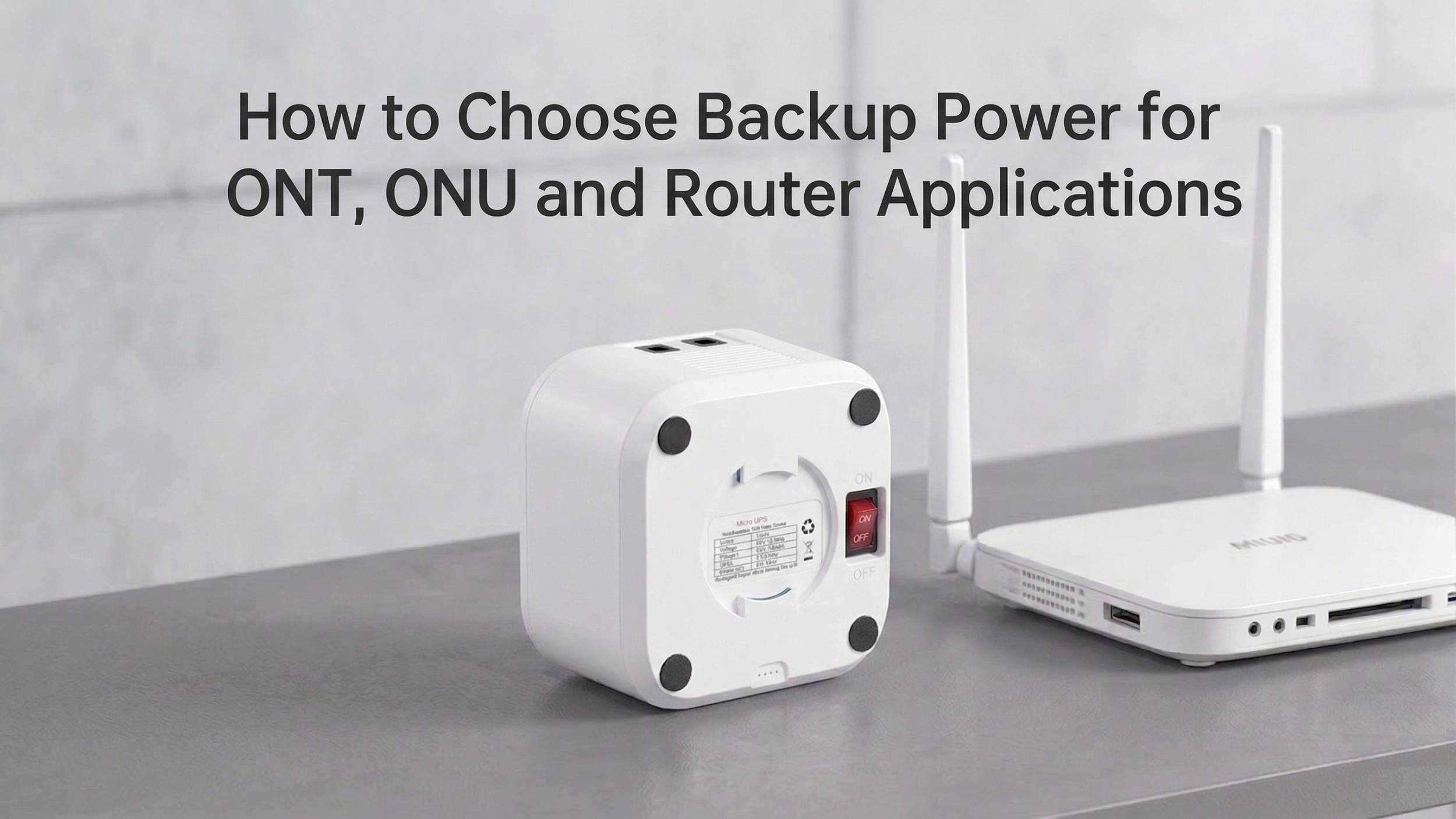
Network intelligence opportunities arise when backup systems include communication capabilities or status reporting. Advanced deployments might integrate backup system status into network management platforms, providing real-time visibility into local power conditions across the service footprint. This data informs infrastructure planning, identifies chronically unstable power zones requiring targeted solutions, and enables proactive subscriber communication during widespread outage events.
Evaluating Deployment Readiness
ISPs considering backup power programs should assess readiness across technical, operational, and business dimensions. Technical readiness requires complete documentation of deployed equipment specifications—actual voltage, current, connector types, and physical installation environments. Without this foundation, backup system selection becomes guesswork prone to costly compatibility failures.
Operational readiness encompasses installation workflow integration, technician training, and support process adaptation. Backup system deployment should enhance rather than disrupt existing installation efficiency. If backup integration adds significant time or complexity to standard installation procedures, adoption suffers and deployment costs escalate beyond business case projections.
Business readiness balances program costs against quantified benefits. Initial backup unit costs, ongoing battery service (if applicable), and program management overhead must align with measurable improvements in subscriber satisfaction, support cost reduction, churn prevention, or premium service revenue. Shanghai Mylion New Energy Co., Ltd. works with ISP customers to structure programs matching technical requirements with business objectives—whether optimizing for lowest total cost, maximum reliability, or premium service differentiation.
ISPs seeking to implement systematic backup power strategies benefit from suppliers with genuine telecom and broadband deployment experience. MYLION’s focus on Mini DC UPS, telecom BBU systems, and project-based technical matching reflects over 13 years of working specifically with ISP deployment challenges rather than adapting generic consumer products to professional applications. This specialization manifests in practical details—connector options reflecting actual equipment diversity, current ratings based on real device behavior rather than theoretical calculations, and OEM support structures designed around ISP procurement and deployment cycles.
As broadband infrastructure evolves and subscriber expectations for always-on connectivity intensify, ISP backup power transitions from optional enhancement to essential service infrastructure. Providers developing systematic deployment strategies today position themselves for sustainable competitive advantage in reliability-focused markets while building operational foundations that scale across growing subscriber bases and expanding service portfolios.
http://www.myliontech.com
Shanghai Mylion New Energy Co.,Ltd. -
AuthorPosts

- You must be logged in to reply to this topic.