- This topic is empty.
-
AuthorPosts
-
2026-08-13 at 5:40 pm #65567
Container format and heavy-duty capability are separate specifications, and a unit can have one without the other. Buyers searching for a containerised mobile charging station usually need both, so the evaluation should test them separately.
MPMC POWERTECH CORP. manufactures container-format mobile charging equipment as part of its BCH Series. The BCH-500-1000 is documented as a 20 ft container-format unit at 19,800 kg, with 500 kW DC charging output and 1,075 kWh of onboard storage.
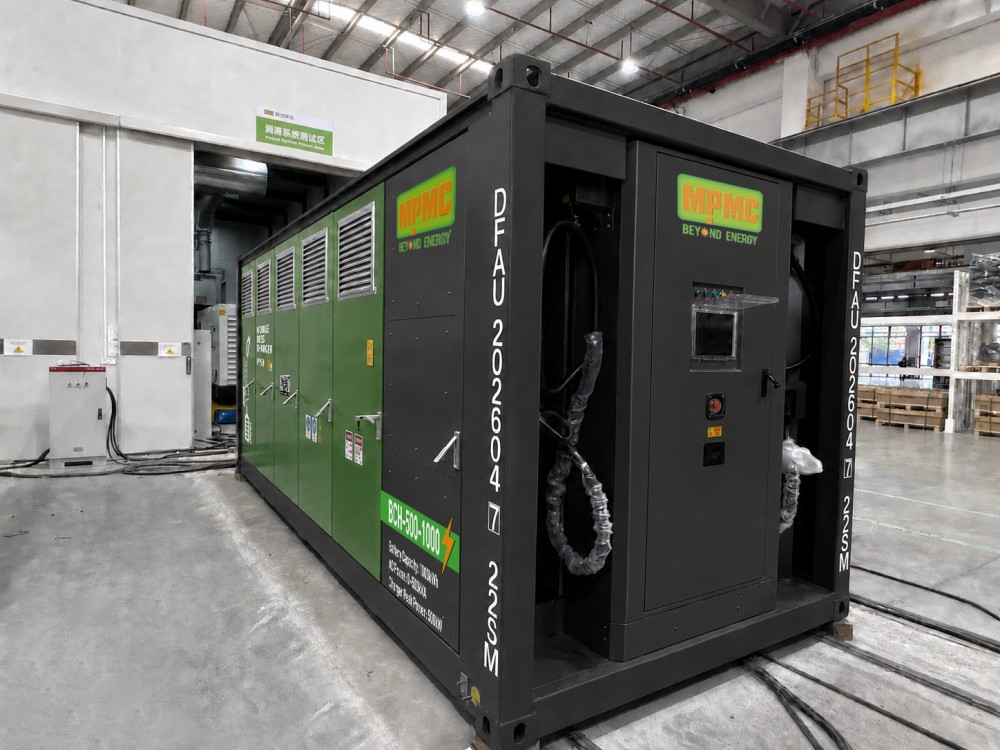
MPMC BCH-500-1000 mobile BESS charger in container format. 500 kW DC output, 1,075 kWh onboard battery.
What the Container Format Contributes
Factory integration
Battery racks, power conversion, thermal management, fire detection and control wiring are assembled and tested before shipment. On-site work reduces to positioning, external connection and commissioning.
Standard logistics
An ISO container footprint moves on normal road and sea transport, and the same enclosure protects the equipment in transit and in service. For an operator moving equipment between sites or countries, this removes a class of transport engineering.
Outdoor rating
MPMC lists IP54 system protection across the BCH range, with LCAC liquid cooling and aerosol fire protection to CE on the BCH-275-200 and above. Container-format units are designed to stand outdoors without additional shelter.
What it costs
Weight and lifting. A 20 ft container-format unit at 19,800 kg requires crane or heavy forklift handling and adequate ground bearing. A trailer-mounted alternative at 2,800 kg does not. That difference should be assessed against the actual sites the unit will serve.
What Makes a Unit Heavy-Duty Capable
Four specifications separate a heavy-duty unit from a scaled-up light-vehicle charger.
Specification
Why it matters for heavy-duty charging
MPMC’s documented position
Onboard energy capacity
Heavy vehicles and machinery transfer far more energy per session
407 kWh to 1,075 kWh on the BCH-600-400, BCH-800-600 and BCH-500-1000
Connector current rating
Higher current is required to complete a session within a working window
CCS2 350 A × 2 on the BCH-600-400 and above
DC voltage window
Machinery packs often sit below road-vehicle voltages
DC 50 to 1,000 V on the BCH-275-200 and above
Thermal management
Sustained high-power delivery generates significant heat
LCAC liquid cooling across the range; 6.7°C temperature control precision listed
Capacity is the specification most often under-checked. A unit with a high output rating and modest onboard storage will deliver its rated power briefly and then need replenishing, which is a poor fit for heavy-duty duty cycles.
MPMC Container and Large-Format Models
Model
DC charging output
Battery capacity at 25°C
AC input rated power
AC output rated power
Weight
BCH-600-400
400 kW
407 kWh
280 kW
200 kW
8,300 kg
BCH-800-600
600 kW
610.6 kWh
280 kW
200 kW
15,000 kg
BCH-500-1000
500 kW
1,075 kWh
560 kW
500 kW
19,800 kg
Container loading is listed as one unit per 20 ft container for the BCH-600-400 and BCH-800-600, and a 20 ft GP format for the BCH-500-1000.
Note that the BCH-500-1000 carries the largest onboard battery but not the highest DC output. The BCH-800-600 delivers more power from less stored energy. Which suits a given site depends on whether the constraint is session duration or daily throughput.
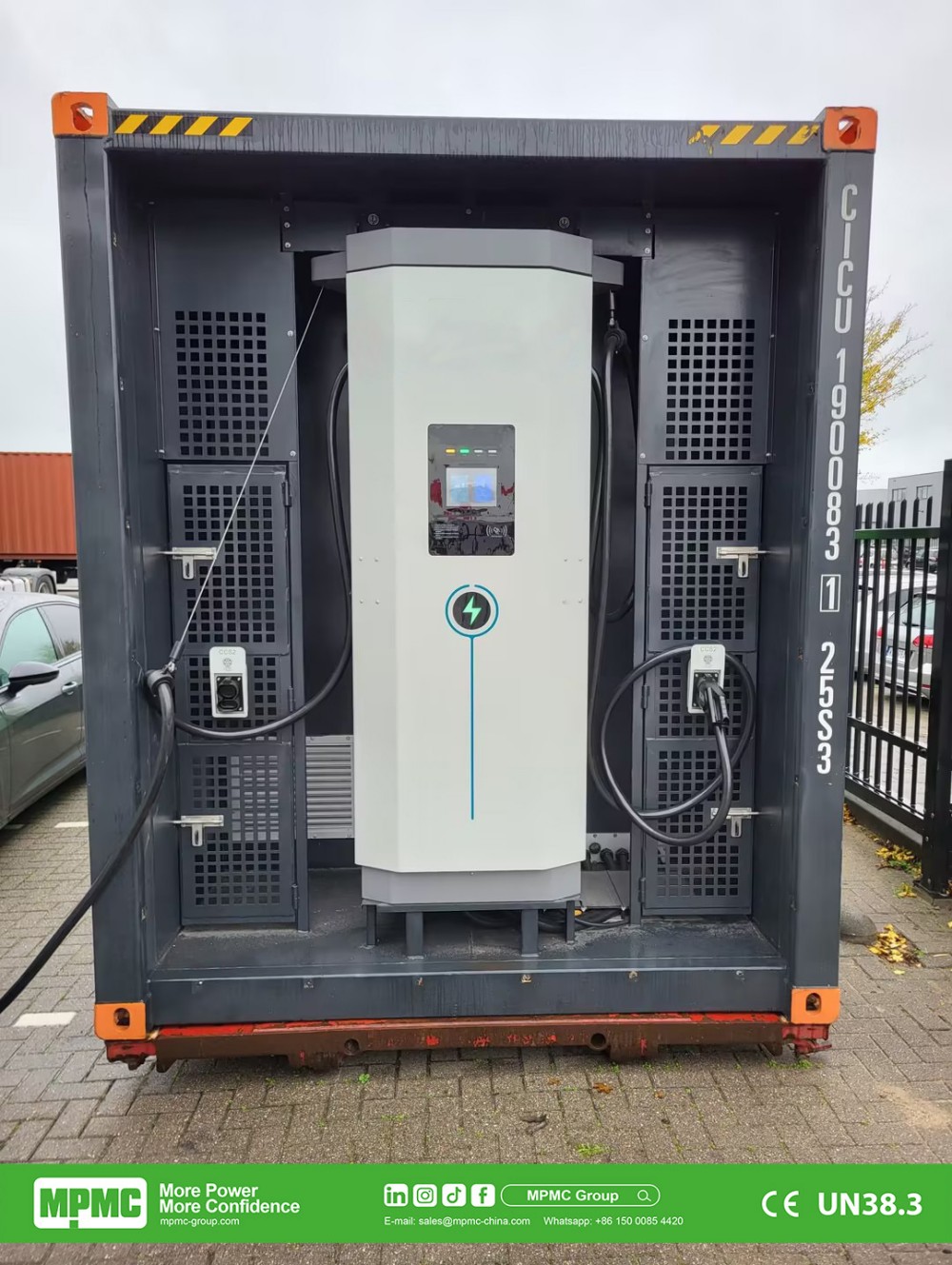
MPMC BCH-500-1000 mobile BESS charger, charging bay detail. CCS2 350 A connectors with a 6 m cable.
How to Evaluate a Manufacturer
The following criteria separate a project-grade supplier from a reseller assembling bought-in components.
Battery design and testing. Ask what cell chemistry and pack architecture are used, and what safety testing has been carried out. MPMC describes the BCH battery as a blade LFP pack with a high-strength structural architecture, listing test coverage for fire, water immersion, high-impact collision and crush, with a 65% larger heat dissipation area than conventional designs and 390 Wh/L energy density.
Manufacturing base. Ask where the unit is built and what processes are in-house. MPMC lists battery pack and BESS assembly lines at its Yangzhong facility in Jiangsu, described as a 19,000 m² workshop with a 3,300 m² research and development centre, established in 2025.
Software and integration. Ask which charging protocols are supported and whether an open interface exists. MPMC lists OCPP 1.6 on the BCH-80-70 and on the BCH-275-200 and above, an EMS with 4G connectivity across the range, an open API and optional RFID payment integration.
Compliance evidence. Ask which certificates apply to the exact model and destination. MPMC’s published product certification list includes CE, TUV, SGS, UN38.3 for battery transport, SABER, France BV, Russian Customs Union, Nigeria SONCAP, China TLC and UL.
Service route. Ask who commissions the unit, who supplies spares and what the diagnostic path is. For remote deployments, confirm what can be resolved without a site visit.
Units in Service
Location
Configuration
Application
Netherlands
BCH-275-200 and BCH-500-1000
Grid-connected EV charging for port and logistics operations
Netherlands
BCH Series, 500 kW / 1,000 kWh integrated unit; 1 MWh
Solar and storage grid-connected EV charging station
Norway
BCH Series, 2 MWh total; 500 kW and 1,000 kWh per unit
Off-grid construction machinery charging
Container or Trailer: A Short Decision Test
The format question resolves against four site facts, not against a preference.
Site fact
Points to container format
Points to trailer format
How often the unit moves
Set once for a long period
Relocated between sites regularly
Lifting equipment available
Crane or heavy forklift on site
Nothing beyond a tow vehicle
Ground bearing at the position
Confirmed for 8,300 to 19,800 kg
Limited or unverified
Onboard energy required
Above roughly 400 kWh
Below that, where the BCH-275-200 at 203.5 kWh suffices
Where the answers split, the trailer-mounted BCH-275-200 at 2,800 kg usually wins on utilisation even if it loses on capacity, because a unit that can be repositioned earns more days than one that cannot.
Whichever format is chosen, close the same items before ordering: onboard capacity against daily energy separately from output rating, connector standard, current rating and DC voltage window against every vehicle, cable reach against the parking layout, AC output rating if site loads will be served, OCPP and API support against the existing platform, temperature and altitude derating, and destination certificates. MPMC’s published warranty for the BCH-275-200 and above is 3 years or 1.6 MWh/kWh total output, with a 5-year or 2.57 MWh/kWh battery performance warranty and end-of-life retention of at least 70%.
Where Buyers Discover the Cost Too Late
Container-format purchases rarely go wrong on the electrical specification. They go wrong on handling.
MPMC lists the BCH-600-400 at 8,300 kg, the BCH-800-600 at 15,000 kg and the BCH-500-1000 at 19,800 kg, each loading one unit per 20 ft container. Those figures set three requirements that are outside the supplier’s scope and easy to leave unowned: crane or heavy forklift availability at the standing position, verified ground bearing beneath it, and a delivery route that accepts the vehicle carrying the container.
Sites that confirm all three before the order proceed straightforwardly. Sites that confirm them on the day of delivery incur crane hire at short notice, temporary ground works, or a unit standing on a hardstanding it was not designed for.
The check costs an afternoon. It is worth doing before the format is chosen rather than after, because it occasionally reverses the decision in favour of the trailer-mounted BCH-275-200 at 2,800 kg.
https://www.mpmc-group.com/
MPMC Powertech Corp. -
AuthorPosts

- You must be logged in to reply to this topic.