- This topic is empty.
-
AuthorPosts
-
2026-10-09 at 5:27 pm #66045
48V DC Servo Motor Drivers for Logistics Robotics in 2026
Battery-powered logistics equipment — AGVs, AMRs, automated warehouse shuttles, and mobile picking platforms — puts a specific set of demands on motion control. The drive has to run from a low-voltage DC bus, fit into a chassis that has no spare cubic inches, and hold position repeatably across thousands of cycles a day. For automation engineers specifying that layer, 48V DC servo motor drivers with a compact, integrated design have become a practical answer rather than a compromise. This article explains the engineering problem, the design options, and how LICHUAN‘s DC servo and integrated motor platforms address it.
The Constraints of Mobile Logistics Platforms
Warehouse automation is a space- and energy-constrained environment. Each AGV or AMR carries its own battery, its own controller, and a limited mounting envelope. Adding four separate motor-and-driver pairs multiplies three problems at once: wiring burden, panel space consumption, and electromagnetic interference between power and signal lines. In machines that are already tight on both volume and cable routing, those three costs compound quickly.
Voltage is the other constraint. Mobile platforms typically operate from low-voltage DC rails, so the servo system must be engineered for that domain rather than adapted from an AC industrial drive. That is precisely the space where DC servo systems rated for 24V–48V operation and a 100W–1500W power band are designed to sit, covering everything from light steering and lift axes to medium-duty traction and roller drives.
Why Integrated Motor-Driver Units Fit Mobile Equipment
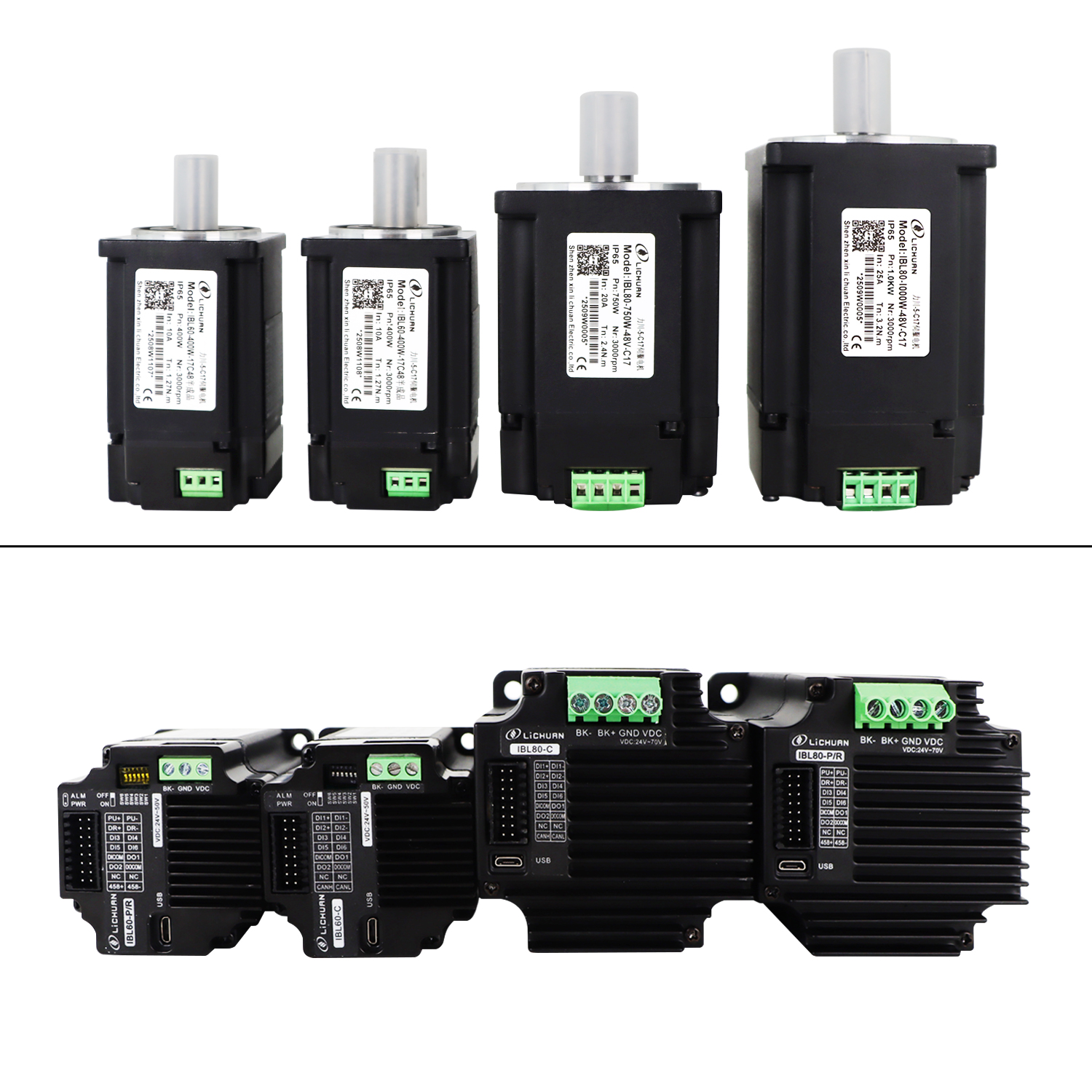
The Integrated Motors category — all-in-one servo and stepper units with the driver built into the motor body — exists to remove exactly the costs described above. In this architecture, the motor and driver are combined in one package, which eliminates the separate driver connections, shortens cable runs, frees cabinet and chassis space, and reduces the EMI exposure that comes with long power leads between discrete components.
Control flexibility matters just as much. Integrated units of this type support Pulse, RS485, and CANopen control modes, so an engineering team can standardize on a fieldbus across a fleet or drop back to pulse control on a simpler axis without changing the hardware family. Variants are available in both servo and stepper versions, letting one mechanical footprint serve different torque and precision requirements.
LICHUAN’s Position in Low-Voltage Servo Motion
Shenzhen Xinlichuan Electric Co., Ltd., operating under the brand LICHUAN, was founded in 2009 and is headquartered in Shenzhen, China. The company is an industrial automation control manufacturer with global export reach across North America, South America, Europe, Russia, East Asia, Southeast Asia, the Middle East, and Africa. Its stated strategic position is "High Quality, High Cost Performance" — delivering servo-like precision and reliability in stepper-class systems at a lower cost point than comparable AC servos.
For logistics robotics specifically, the relevant product line is DC Servo Systems: drivers and motors spanning 24V–48V with a 100W–1500W power range. The target pain point is explicit — the need for low-voltage, compact servo motion in AGV/AMR and other mobile equipment — and the differentiated value is straightforward: low-voltage operation that suits battery-powered platforms, over a power band that covers light to medium servo loads. Application areas listed for the line include warehouse automation, AGV/AMR mobile platforms, and logistics robotics.
Feedback and Efficiency in the Control Loop
Two engineering characteristics from LICHUAN’s broader motion platform are worth noting for mobile applications. The first is feedback and processing: closed-loop systems use 1000PPR encoders with 32-bit DSP processing to provide real-time position feedback and eliminate the step loss and position error common to open-loop steppers — plus no tuning is required, so units are plug-and-play across different mechanical loads without gain parameter adjustment.
The second is efficiency. LICHUAN’s smart current control is specified for up to 40% energy reduction. On a battery-powered AGV, current draw translates directly into runtime and charging cycles, so drive-level efficiency is not a secondary specification — it is a fleet-level operating cost.
A Deployment Example: AGV/AMR Platforms
In a documented logistics robotics case, the customer builds AGV/AMR mobile platforms for warehouse automation. The business scenario required compact, low-voltage servo power for mobile robot motion control. The solution deployed was 48V DC integrated servos — the integrated form factor matched the chassis constraints, and the 48V rating matched the platform’s DC bus. A second application in the same integrated-motor family serves industrial sewing machine control, where specialized motor control was the requirement and integrated stepper/servo motors were the solution.
Durability, Testing, and Certification
Mobile equipment operates in environments that are hard on electronics — vibration, dust, temperature swings, and continuous duty cycles. LICHUAN specifies IP65 and IP66 protection ratings for harsh environments, and every unit is subject to 24-hour high/low temperature aging tests. The company holds ISO9001:2008 quality management system certification, along with CE and RoHS certification — the latter two being the market-access documents most relevant to international OEM/ODM programs.
Manufacturing and Supply
Production runs in a 4,410-square-meter self-owned factory equipped with 9 production lines and 30+ specialized machines, staffed by a team of over 160 employees including dedicated procurement and finance functions. As of late 2016, the company had filed 23 patent applications, been granted 20 patents, and held 11 software copyrights. OEM/ODM customization is offered alongside standard product supply.
A Practical Specification Checklist
For engineers evaluating 48V DC servo drivers for a logistics platform, the decision points tend to converge on a short list:
- Confirm the DC bus range — 24V–48V support covers common AGV/AMR battery architectures.
- Size the power band against the axis — 100W–1500W spans steering, lift, and traction duties.
- Decide between discrete and integrated motor-driver designs based on chassis volume and cable routing.
- Verify the control interface the fleet standardizes on — Pulse, RS485, or CANopen.
- Check the IP rating against the operating environment.
- Ask how the drive affects energy consumption, since runtime is a fleet economics question.
- Confirm certification coverage (CE, RoHS) and quality process (ISO9001:2008, aging tests) for the target market.
Key Takeaways
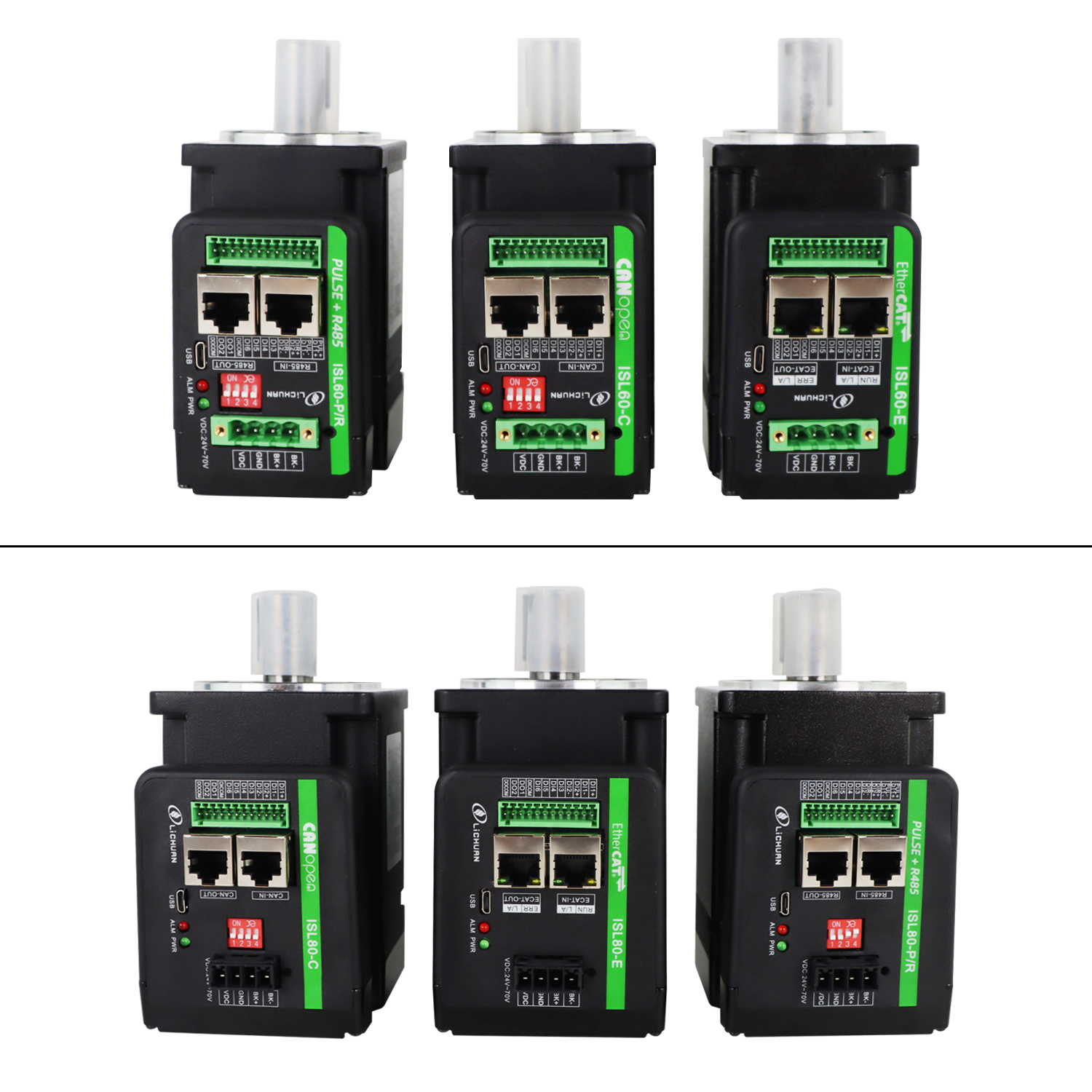
Compact, low-voltage servo motion is now a first-class design choice for logistics robotics rather than a workaround. Integrated motor-driver units remove wiring, space, and interference costs; a 24V–48V, 100W–1500W DC servo range matches mobile platform power architecture; and closed-loop feedback with 32-bit DSP processing delivers the positioning reliability that warehouse duty cycles demand. LICHUAN, through Shenzhen Xinlichuan Electric Co., Ltd., builds its offering around that combination — integrated, low-voltage, certified, and positioned on cost-performance rather than premium pricing.
http://www.lichuanservo.com
Shenzhen Xinlichuan Electric Co., Ltd. -
AuthorPosts

- You must be logged in to reply to this topic.