- This topic is empty.
-
AuthorPosts
-
2026-09-22 at 4:14 pm #65923
How to Estimate Real Mini UPS Runtime for Routers and ONTs
When a power outage strikes, the first devices to go dark are typically the router, modem, or ONT sitting quietly on a shelf. For telecom operators, ISPs, and broadband network companies, that brief interruption can mean hundreds of service calls and significant subscriber dissatisfaction. The question most network engineers and procurement managers ask is straightforward: how long will a mini UPS actually keep these devices running? The answer, however, depends on a set of variables that are frequently underestimated or ignored entirely.
Why Rated Capacity Rarely Equals Real Runtime
Battery energy is almost always expressed in watt-hours (Wh) on a product datasheet, and runtime calculations appear deceptively simple: divide energy by load power, and the result is runtime in hours. In practice, several factors compress that theoretical number before a single minute of backup power is delivered.
Conversion efficiency losses are the first hidden drain. Every DC-to-DC conversion stage inside a mini UPS consumes a fraction of the stored energy as heat. A unit rated at 44.4Wh does not deliver 44.4Wh to the connected device; the usable output is always lower.
Battery chemistry behavior introduces a second variable. Lithium-ion cells, for example, do not discharge at a perfectly flat voltage. As the cell approaches depletion, output voltage sags, and the protection circuit cuts power before the cell is fully exhausted — a design choice that protects battery longevity but reduces usable runtime.
Temperature and aging compound these effects over months of deployment. A unit installed in a telecom cabinet exposed to elevated ambient temperatures will degrade faster than one kept in a climate-controlled environment.
Peak and startup current represent perhaps the most commonly overlooked factor. Routers, ONTs, and gateways do not draw a constant, smooth current. They spike at startup, and some — particularly high-performance WiFi 6/7 routers and storage-integrated gateways — sustain elevated current draw during active sessions. If the mini UPS output ceiling cannot absorb these peaks, the backup episode ends prematurely or the device resets anyway, defeating the entire purpose.
The Right Calculation Framework
A field-accurate runtime estimate requires working from the real working current of the connected device, not the adapter label or the device’s maximum rated wattage. The correct sequence is:
Step 1 — Measure or verify the actual working current. The nameplate on an AC adapter shows a worst-case ceiling, not the typical draw. For a 12V router that ships with a 2A adapter, the real operating current at idle may be 0.6A and under heavy traffic load may reach 1.2A. Using 2A as the baseline produces a pessimistic — and misleading — estimate.
Step 2 — Identify the peak or startup current. This is the brief surge the device draws when powering on or when a high-demand process initiates. A mini UPS must be rated to handle this peak without triggering its overcurrent protection; otherwise the device will not even complete its boot cycle on battery.
Step 3 — Apply a derating factor for conversion losses. A conservative derating of 80–85% on the usable battery energy is a reasonable starting point for most DC mini UPS deployments.
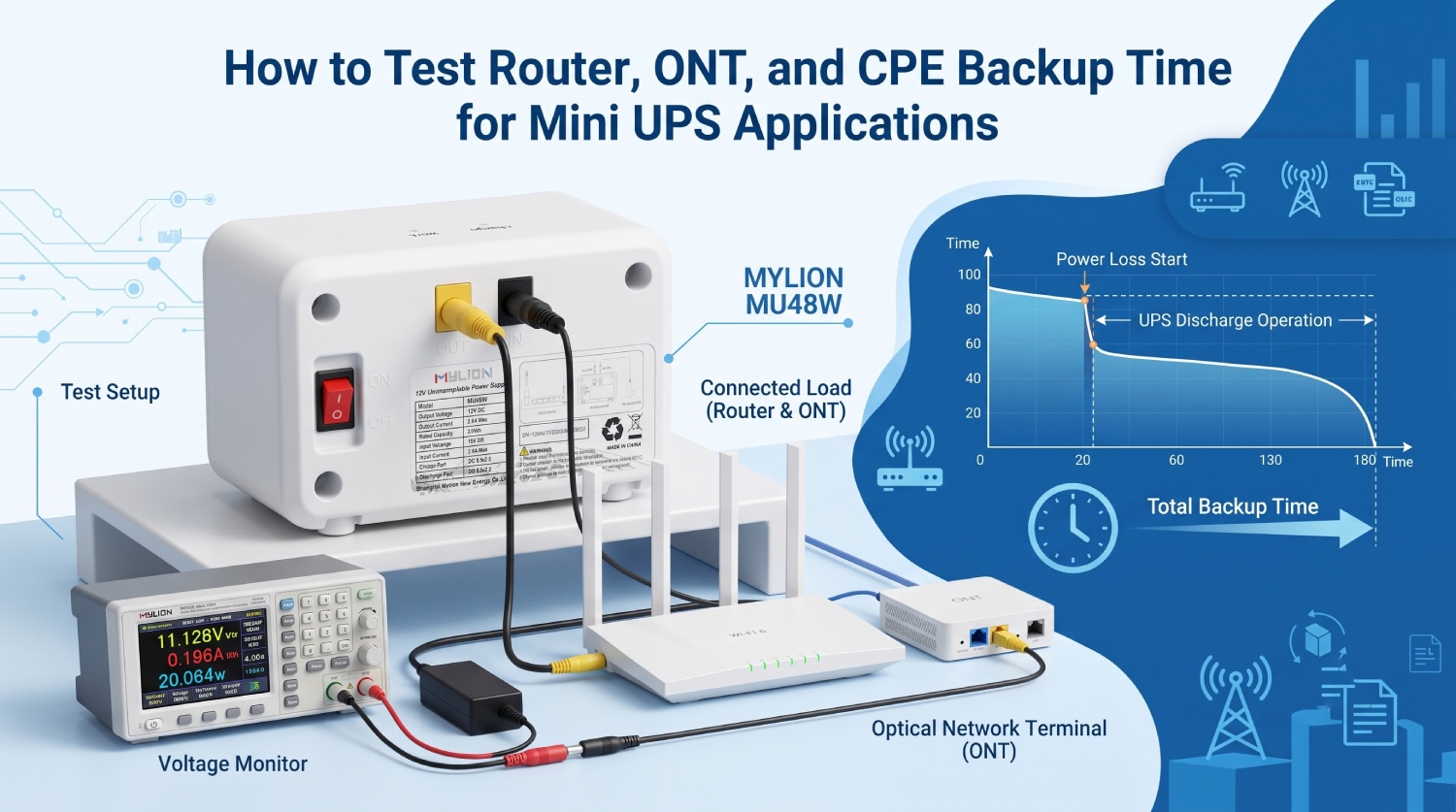
Step 4 — Divide usable energy by average working power. Average working power equals the verified working voltage multiplied by the typical working current. This yields a runtime figure that reflects what the device will actually experience in the field.
Step 5 — Validate with a sample test. Calculated estimates should always be confirmed against a real unit under load before a project commitment is made, especially for large-scale ISP deployments where thousands of units will be installed at subscriber premises.
Matching the Mini UPS to the Device: Where Selection Errors Occur
The most consequential decisions happen before runtime even enters the conversation. Selecting the wrong output voltage, an incompatible connector, or an insufficient current ceiling will cause the backup system to fail regardless of how much battery capacity is installed.
Voltage compatibility must be verified precisely. Most home and small-business routers and ONTs operate on 12V DC, but the tolerance window matters. A device expecting regulated 12V may behave erratically if supplied with a drifting voltage under load.
Connector matching is a detail that generates a disproportionate share of field failures. DC barrel connectors come in multiple outer and inner diameter combinations — DC5521 and DC5525 are common but are not interchangeable without an adapter, and a loose fit can interrupt backup power at a critical moment.
Output current ceiling determines whether the mini UPS can sustain the connected load indefinitely or whether it will throttle or shut down. A unit with a 2.5A continuous output ceiling paired with a high-power router that regularly draws 3.5–4A under load will not provide reliable backup.
These are the exact failure modes that Shanghai Mylion New Energy Co., Ltd., operating under the brand MYLION, has built its product portfolio to address. With more than 10 years of experience in mini UPS development and more than 13 years in lithium battery technology, MYLION structures its B2B engagement around technical confirmation before any unit ships — verifying real device voltage, working current, peak and startup behavior, and installation environment to eliminate selection errors at the project level.
Applying the Framework Across the MYLION Product Range
Understanding the calculation framework makes it straightforward to map the right product to the right application.
For a standard 12V router or ONT drawing approximately 0.8–1.2A under normal traffic conditions, a unit like the MU68W — carrying 44.4Wh of energy and a 12V/3A maximum output — provides substantial runtime margin. Applying a conservative derating, the usable energy delivers comfortable backup coverage for typical short-to-medium outages in residential ISP deployments.
Where the connected device is a high-performance gateway or a WiFi router with elevated current demands, the MU65W is engineered for the task. Its 12V output sustains 4A continuously with a 5A peak ceiling, drawing on 56.16Wh of stored energy. The 6A input rating means recharge is equally efficient. This specification directly addresses the scenario where standard 2.5A units fail silently under a high-load router.
Projects requiring the longest possible backup window without sacrificing output power should evaluate the MU35W / MU35L series, which combines the 4A continuous / 5A peak output profile with a 75.6Wh battery — a combination positioned for professional gateways in environments where outages can extend well beyond the short blips that standard units are designed to cover.
For installations combining a 12V router with USB-powered accessories — a common configuration in small office and home office environments — the MUJ46 provides simultaneous 12V DC and dual 5V USB outputs within an 18W total system ceiling, backed by 37.44Wh of capacity.
At the infrastructure level, where a single wall outlet needs to support both an ONT and a router, the ML1202AC simplifies deployment by accepting 100–240V AC input and delivering two independent 12V/2A outputs from a LiFePO4 battery — eliminating the need for an external DC adapter and reducing cabling complexity at the subscriber premises.
LiFePO4 Chemistry and Its Runtime Implications
Battery chemistry has a direct bearing on both runtime consistency and long-term deployment economics. LiFePO4 (lithium iron phosphate) cells maintain a notably flat discharge curve compared to standard lithium-ion chemistries, meaning the output voltage stays stable for a larger portion of the discharge cycle. This behavior reduces the gap between rated capacity and delivered runtime — a practical advantage in field deployments where predictable backup duration matters.
LiFePO4 also carries a substantially longer cycle life, which affects the total cost of ownership calculation for operators deploying equipment at scale. A unit that maintains its rated capacity through a greater number of charge-discharge cycles requires less frequent replacement, lowering long-term per-site operating costs.
The ML1202AC and the development-stage MU248 are among the MYLION products incorporating LiFePO4 chemistry, reflecting a deliberate alignment with deployment scenarios where longevity and voltage stability are prioritized.
Emerging Needs: USB-C PD and Higher-Voltage Telecom Equipment
The transition toward WiFi 6 and WiFi 7 devices is introducing a new compatibility challenge. Many next-generation routers and CPE devices are moving away from traditional DC barrel connectors toward USB-C Power Delivery as their primary power interface. A mini UPS designed around DC5525 connectors and 12V rails is simply incompatible with these devices.
MYLION is addressing this transition through the project-evaluation direction represented by the MUC85, which accepts USB-C PD input at 65W standard and up to 100W maximum, and delivers USB-C PD output at up to 20V/3.25A (65W) alongside a secondary USB-C output at up to 12V/2.5A (30W), backed by 92.16Wh of battery energy. This positions the platform for modern WiFi devices that require USB-C Power Delivery.
At the higher end of the voltage spectrum, the MU248 development direction targets wireless CPE and radio bridge equipment operating at 24V and 48V — segments where standard 12V mini UPS products are structurally unsuitable. Its LiFePO4 battery, 48V/60V DC input, independent 24V (3A) and 48V (1A) outputs, and 100W system ceiling outline a path toward serving telecom equipment categories that have historically lacked compact backup options.
Practical Guidance for ISP and Telecom Project Teams
For procurement and technical teams evaluating mini UPS options for broadband or telecom deployments, the following principles reduce selection risk:
Do not use adapter labels as the load specification. Measure or obtain the verified working current of the device, not the adapter’s maximum output.
Account for peak current in addition to continuous current. A unit that cannot absorb the startup surge of the connected device provides no effective backup.
Confirm connector compatibility before procurement. DC5521 and DC5525 are different connectors. USB-C PD devices require a PD-capable output, not a standard DC barrel.
Request sample validation before mass deployment. Runtime and compatibility claims should always be verified under real-load conditions with the actual target device before a large-scale rollout.
Consider total deployment life, not just unit cost. LiFePO4 chemistry and robust cycle life ratings affect the multi-year cost of a large subscriber-side installation program.
MYLION’s B2B service model is structured to support each of these steps — from requirement analysis and model matching through sample testing support, connector and cable matching, OEM/ODM private labeling, and documentation coordination — providing a framework for reducing avoidable selection errors in professional broadband and telecom backup projects. Further technical information is available at http://www.myliontech.com.
http://www.myliontech.com
Shanghai Mylion New Energy Co.,Ltd. -
AuthorPosts

- You must be logged in to reply to this topic.