- This topic is empty.
-
AuthorPosts
-
2026-11-03 at 5:30 pm #66337
Four physical facts separate a real hurricane shutter factory from a trading office with good photography: an extruder big enough to run the profile, a pretreatment line with at least seven tanks, a coating thickness gauge with batch records, and a mill certificate naming alloy and temper. Every supplier will send a catalogue. Only a factory can show you those four things without rehearsing.
The question of how to choose a hurricane shutter manufacturer in China usually gets answered with certificates and floor area. Neither predicts whether the 900 mm panel you ordered will pass at ±65 psf. What predicts it is tolerance control on the extrusion, film build consistency on the coating line, and whether the fasteners are the grade stated on the drawing.
This checklist is the one we would want a buyer to apply to us. ISAMONROE has run extrusion, coating and assembly in Changzhou since 2010, and we have lost orders to cheaper quotes that could not pass a second shipment.
1. What Should You Verify, in Person or on Video?
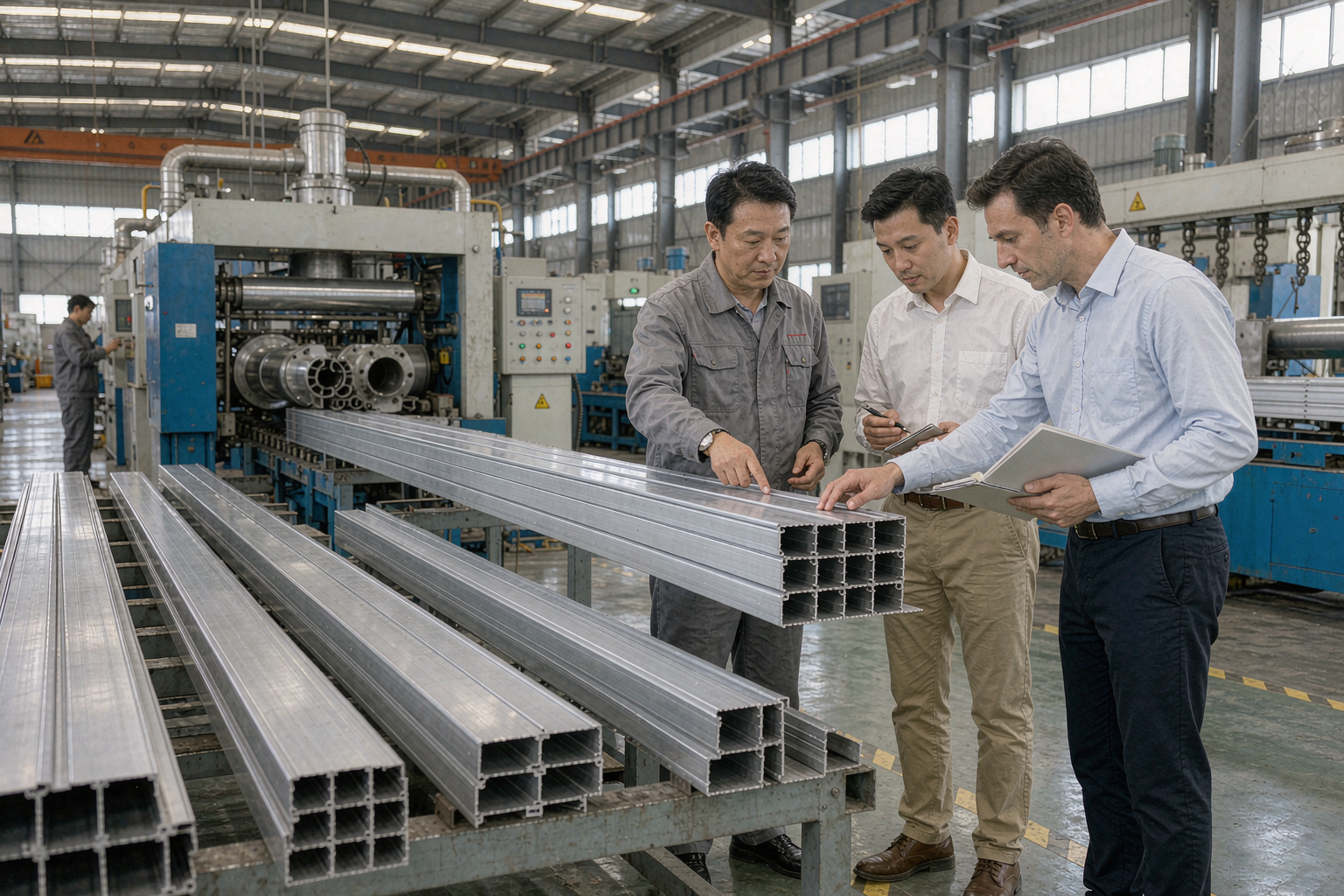
Verify process equipment, then verify records — equipment proves capability, records prove consistency. The distinction matters because a factory can own a coating line and still ship 45 µm on a job specified at 90 µm. Any buyer working out how to verify a Chinese shutter factory before placing an order needs both halves.
• Extrusion. Ask the press tonnage. Louver blade profiles need 600 tons minimum and 1,200 tonnes or more for wide frame sections. Below that, wall thickness varies along the length and your deflection calculation stops being true.
• Pretreatment tanks. Count them. Degrease, rinse, etch, rinse, neutralise, rinse, conversion coating — seven is the working minimum for a coating that survives salt. Four tanks means a shortcut somewhere.
• Film thickness records. Ask to see the gauge and the log for the last batch, not a certificate of conformity. Readings should show a range across five points per metre, and the low end should still be above the specified minimum.
• Mill certificate. 6063-T5 or T6, with heat number. Webster hardness should read 8 or above for T5 and 10 or above for T6. A supplier who cannot produce this is buying scrap-remelt stock and cannot tell you what is in it.
• Hardware segregation. 304 and 316 bins must be physically separate and labelled. Mixed bins are how a coastal order ships with inland screws.
On a remote audit, ask for a continuous unedited walk from the loading bay to the coating line to the assembly area. Then pick three random points and ask the camera to stop. Edited reels are easy; unedited geography is not. A timestamp visible in frame, a gate sign, and the same supervisor appearing twice in the same clothes are all worth more than a certificate wall.
The factory audit questions for aluminum extrusion suppliers that separate real plants from assemblers are narrower than most checklists suggest. Ask what die they use for the blade profile and how many times it has been reworked. Ask how they control wall thickness tolerance, and what the actual range is in millimetres. Ask who does the anodising or coating if it is not in-house, and whether they can show the transfer records. Assemblers answer all three vaguely.
✅ Bottom line: Ask for records, not certificates. A gauge log from last week beats a wall of framed approvals.
2. What Signals Should Make You Walk Away?
A price 30% below the field, a refusal to show the coating line, or a quotation with no film build figure — any one of these should stop the conversation when you are working out how to choose a hurricane shutter manufacturer in China. Each is enough on its own to walk away; together they describe a trading company reselling from an unknown source.
The 30% gap deserves explanation, because buyers read it as efficiency. At the same alloy price, a genuine 1.6 mm blade with 90 µm coating and 316 hardware cannot be produced 30% below a competitor; the metal alone sets a floor. What changes is the blade, the film or the fastener — usually all three, and usually invisibly until the second season.
Other signals worth taking seriously: a showroom in a city with no factory within 200 km; a "testing report" with no laboratory name or sample size; willingness to certify any panel size you ask for; and an export licence with a first shipment date inside the last six months for a company claiming fifteen years of experience.
The practical answer to how to verify a Chinese shutter factory before placing an order is a trial. Order 20–50 m², not a container. Measure film build at five points per panel and record it. Put a sample in a salt spray chamber or send it to a local lab for 500 hours. Check the fastener grade with a magnet and a specification sheet — 316 is non-magnetic, 304 is weakly magnetic, zinc-plated steel is strongly so.
A trial costs a few hundred dollars in freight and settles every claim the catalogue made. Changzhou Isamonroe Shutters Co., Ltd. ships trial batches from 20 m² and credits the sample cost against the first wholesale order, because a buyer who measures is a buyer who reorders.
✅ Bottom line: Buy a trial before a container. Twenty square metres of measurement beats a hundred pages of certificates.
Frequently Asked Questions
Q: Is a trading company always a bad choice?
A: Not always — a good one consolidates several product lines and handles export paperwork well. The risk is traceability. When something fails, you need to know which line made it. If you are buying hurricane-rated product, how to choose a hurricane shutter manufacturer in China comes down to whether the entity that tested the assembly is the entity that produced it. If the answer is unclear, buy direct — which is why ISAMONROE sells factory-direct rather than through resellers.
Q: How much does a third-party inspection cost?
A: Roughly USD 300–800 per inspector-day with SGS, BV or Intertek, plus travel. For a first order it is cheap insurance. Specify what to check: film build readings with the instrument model, fastener grade, packing condition, and a container loading photo set. A generic "quality inspection" report that only counts cartons tells you nothing.
Q: What should be in the purchase order?
A: Alloy and temper, blade and frame wall thickness in millimetres, film build range, powder standard, salt spray hours, fastener grade, packing method, and the test reports to be supplied. These are exactly the answers good factory audit questions for aluminum extrusion suppliers produce, which is why the audit should happen before the PO, not after. A custom order without those clauses is an order for a shape, not a specification.
Next Step
Ask us the four questions in this article and see what comes back: press tonnage, tank count, the last batch's gauge log, and a mill certificate. ISAMONROE answers all four with documents, and we will host a live unedited walk of the plant before you commit to anything. As a China manufacturer with our own extrusion and coating lines, we would rather be audited than believed. Start with the specs on our windproof aluminum shutters page, or see the full capability set on our about us page.
http://www.isamonroeshutters.com
ISAMONROE -
AuthorPosts

- You must be logged in to reply to this topic.