- This topic is empty.
-
AuthorPosts
-
2026-11-10 at 5:29 pm #66388
For one station on a deadline, the local fabricator usually wins. For a repeatable multi-station signage program, the export factory wins on landed cost — and the gap widens with every station you add.
Most buyers compare the two on the wrong line. They read the fabricator's quote and the factory's FOB price side by side and stop there. The real question in the china signage factory vs local sign shop cost decision is what each quote leaves out: the local quote hides one-off fabrication variance, the factory quote hides freight, duty and time. Below, both sides get built up line by line.
1. What does a local sign shop actually charge you for?
A local quote buys one-off fabrication, and every station repeats that one-off cost. A typical single-station package — one 6–9 m pylon, canopy fascia, price sign and pump toppers — lands in the $38,000–55,000 range from a local shop in 2026. Where the money goes:
• Materials at distributor price — aluminium, acrylic and LEDs bought retail-plus, typically 20–40% above factory-direct cost.
• Labour hours — skilled fabrication at $35–65/hour, and a first-of-its-kind pylon always takes longer than the drawing promises.
• Permit engineering — structural calcs and a licensed engineer's stamp, $600–2,500 per design.
• Risk premium — a shop that builds one station a quarter prices in rework and warranty; the quote has no tooling to amortize.
None of this is wrong. It is simply the price of building number one every time. Station number four costs the local shop almost as much to build as station number one, because nothing carries over — no moulds, no powder lot reserved for the program, no batch colour record from the previous three sites.
The hidden local line is repetition risk. When procurement runs the china signage factory vs local sign shop cost exercise across a five-station program, the local option quietly re-buys the same engineering four times and matches four different reds, because each build starts from a fresh Pantone chip. On a national program that variance is not a cosmetic problem; it is the difference between a brand standard and four local interpretations of one.
✅ Bottom line: A local quote prices craftsmanship and speed; it cannot price tooling, powder lots or colour masters — which is why its number barely moves as the station count grows.
2. What goes into the total landed cost of imported custom signage?
The FOB price is only about 70–80% of the real number. The honest way to run the total landed cost of imported custom signage is to build the stack before comparing it to anything:
• FOB — the same single-station package typically builds out at $22,000–30,000 FOB China, because tooling, powder and labour prices differ, and the design is amortized across the program.
• Freight — a station kit packs into roughly 12–20 m³ knocked down. Full-container freight Asia–US ran $2,500–4,500 in 2026, LCL $90–160/m³, so freight adds about $1,800–3,200 per kit.
• Duty — finished metal signage is commonly classified under HTS 8306.30 at 0–5%, plastics and mixed parts higher; the import duty and freight for signage from china line must be confirmed with your broker against the exact HTS codes, because exclusions and additional actions change year to year.
• Brokerage and inland — $250–500 documentation, plus drayage to site.
• Program buffers — 5% spare panels and a 3–5% rework contingency. Skipping the spares line is how year-three repairs become visible patches.
Add it up and the landed kit lands at $26,000–38,000 — but only if the design repeats. The export route amortizes drawings, moulds and colour masters across the whole station count, which is exactly what a local one-off build cannot do.

The decision rule that survives contact with real projects: below three stations, or with an emergency repair, buy local and buy speed. At five stations or more, or on any repeating kit, run the landed-cost stack — and price the local option for installation only. The strongest hybrid is a China factory building the kit and a local crew hanging it: import the repeatability, hire the ladder time. That hybrid is how most export programs actually run — BIGDIPPER SIGN builds and batches, the local crew measures, mounts and wires.
✅ Bottom line: One station buys local; a program buys imported — because tooling, powder lots and colour masters only amortize when the same kit repeats.
FAQ
Q: How much is import duty on signage from China?
A: Finished metal signs and plates commonly classify under HTS 8306.30 at 0–5%, while plastic and mixed-material components can draw 3–6%. Classification, not the word "signage", decides the rate — and preferential or additional duties change with trade policy. Have your broker confirm the HTS codes against your actual bill of materials before you lock the comparison — a factory that ships export kits weekly keeps its HTS codes on file from the last customs cycle.
Q: What does freight add per station kit?
A: A single-station kit knocks down into roughly 12–20 m³. Shared-container freight added about $1,800–3,200 per kit in 2026, and crated panels survive the trip better than assembled pylons — ask the factory for the crate drawing, not just the freight quote. Freight is the volatile half of the import duty and freight for signage from china equation; duty is stable, freight is not.
Q: How much longer does the import route take?
A: Plan 35–70 days from PO to site — 20–30 days production plus 15–40 days ocean — against 2–4 weeks locally. That gap is the price of amortization, and the 5% spares in the kit are what stop it from becoming a second trip. Anhui Bigdipper Sign Co., Ltd. publishes both numbers per program so the schedule is part of the china signage factory vs local sign shop cost comparison, not a surprise after the deposit.
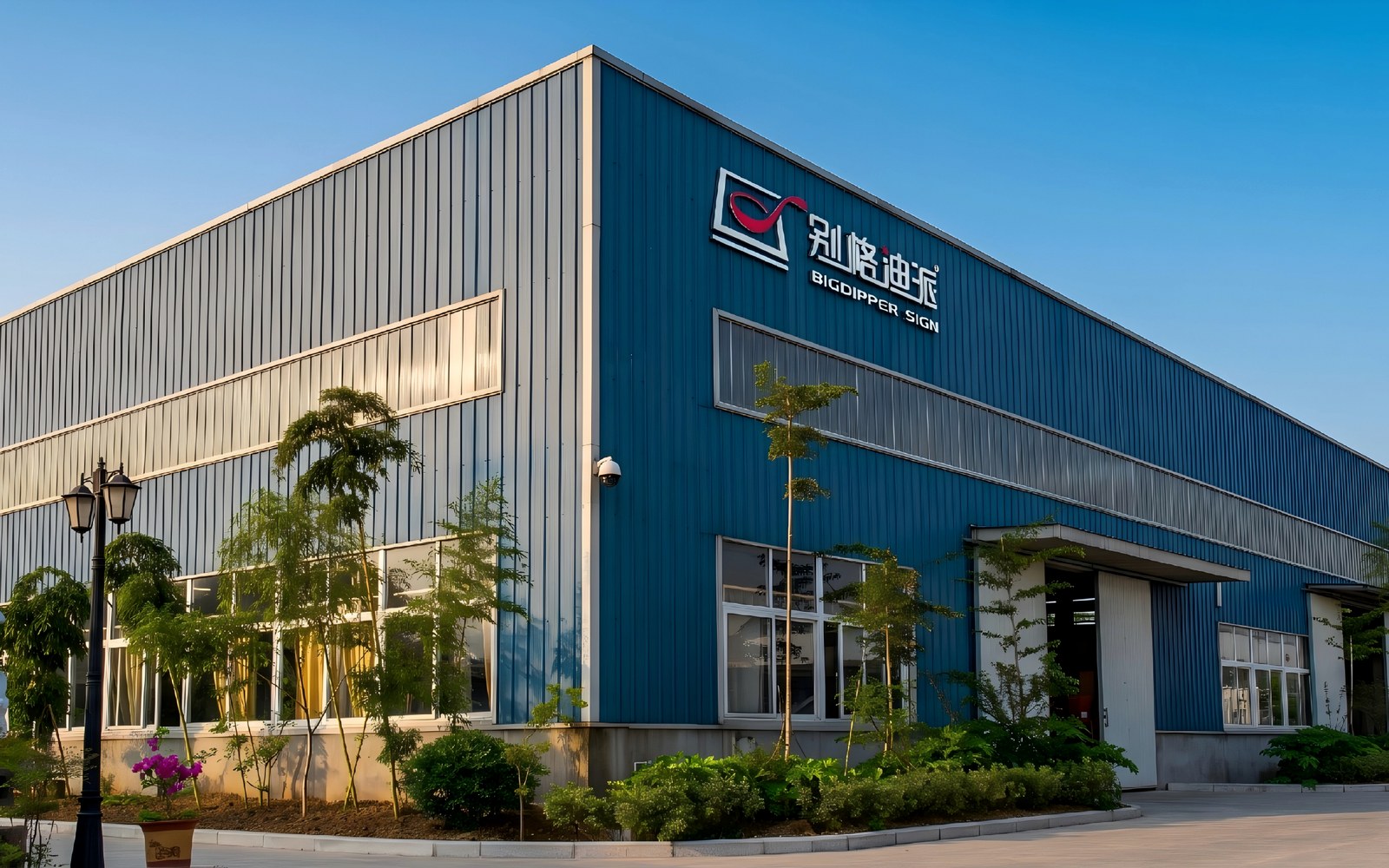
BIGDIPPER SIGN runs a free landed-cost comparison for fuel retail networks: send your bill of quantities and site list, and our team returns a side-by-side — local quote line items versus the total landed cost of imported custom signage from our OEM/ODM program, freight and duty included, with the break-even station count marked. Contact BIGDIPPER SIGN, a China factory with a 300-station VI delivery record — see our contract manufacturing and OEM services or our 300-station national rollout — and get the comparison inside one week.
Published: November 2026 | By BIGDIPPER SIGN Engineering Team
http://www.bdpsigns.com
Anhui Begedipai Signage System Co., Ltd. -
AuthorPosts

- You must be logged in to reply to this topic.