- This topic is empty.
-
AuthorPosts
-
2026-11-12 at 9:39 am #66412
Power over Ethernet looks simple on a diagram: one cable carries both data and power, and a device appears wherever the cable ends. On a pole, a fence line, or a vehicle, PoE meets long cable runs, lightning, water, heat, and equipment from different vendors that do not always agree on how power should be delivered. A rugged 4G PoE router has to cope with all of that while keeping its LTE link alive.
This guide, written for buyers sourcing from a rugged 4G PoE router factory, covers the PoE details that matter most outdoors, the faults that commonly appear in the field, and five practical set-ups using E-Lins LTE PoE models.
Active and Passive PoE: Know Which You Have
Standards-based (active) PoE
IEEE 802.3af, 802.3at, and 802.3bt define how a power source detects a compatible device before supplying power, and how much power each class may draw. Under 802.3af, a port supplies up to 15.4 W; under 802.3at, up to 30 W; under 802.3bt, up to 60 W or 90 W depending on type. Because the source checks the device first, standards-based PoE will not push power into equipment that cannot accept it.
Passive PoE
Passive PoE applies a fixed voltage to the cable without detection or negotiation. It is simple and common in some outdoor equipment, but the voltage on both ends must match, and connecting a non-PoE device to a passive PoE port can damage it. Label passive PoE ports and cables clearly, and never mix passive and standards-based equipment without checking both sides.
Where E-Lins models sit
E-Lins lists both types across its range. The H820QOt outdoor 4G CPE has an IEEE 802.3af/at powered-device interface, and the H820t-P2 offers active PoE Out. The H900t is listed with passive PoE, as is the H820QO-B outdoor board. Check the type for the exact variant before designing the cabling.
PoE In or PoE Out?
PoE In means the router is powered over its Ethernet cable from a switch or injector, which lets it sit far from a socket: on a pole, above a ceiling, or inside a kiosk. PoE Out means the router powers other devices, such as a camera or an access point, which removes the need for a separate switch and supply from the cabinet. Some E-Lins models are offered as PoE In or PoE Out variants of the same platform, such as the H820t, so the direction can be chosen per site.
What Breaks PoE Links in the Field
Cable length
An Ethernet channel is limited to 100 metres. Beyond that, data errors and voltage drop appear. Use a switch or extender part-way for longer runs.
Cable quality
Copper-clad aluminium cable is cheaper than solid copper but has higher resistance, wasting power and generating heat, especially at higher PoE classes. Use solid copper cable rated for outdoor or direct-burial use where it leaves the building.
Surges and lightning
Long outdoor cables pick up surges from nearby lightning strikes and switching events. Fit Ethernet surge protectors at both ends of exposed runs, bond them to a proper earth, and keep cables away from power conductors.
Water
Water entering an RJ45 connector causes corrosion and intermittent faults weeks later. Use sealed cable glands or waterproof connectors and form drip loops so water runs away from entry points.
Budget and heat
A router supplying PoE Out converts and delivers extra power, which raises its internal temperature. Check the total PoE budget, not only the per-port maximum, and remember that cabinet temperatures in sun can be far above ambient.
Five Field Set-Ups
1. Pole-mounted LTE for a building with weak indoor signal
The H820QOt outdoor 4G CPE mounts directly on a pole, with an IP68-rated enclosure and built-in 14dBi high-gain antennas. Its 802.3af/at PoE powered-device interface lets a single cable from an indoor PoE switch or injector carry both power and data, so no power supply is needed at the top of the pole.
2. A cabinet router powering a camera
At a roadside or perimeter cabinet with a DC supply, the H820t-P2 provides active PoE Out to power a camera directly, along with Fast Ethernet ports, Modbus support, and DIN-rail mounting. Where the site also needs dual SIM resilience, the H900t-P2 combines PoE Out with dual SIM.
3. A router powered from a switch
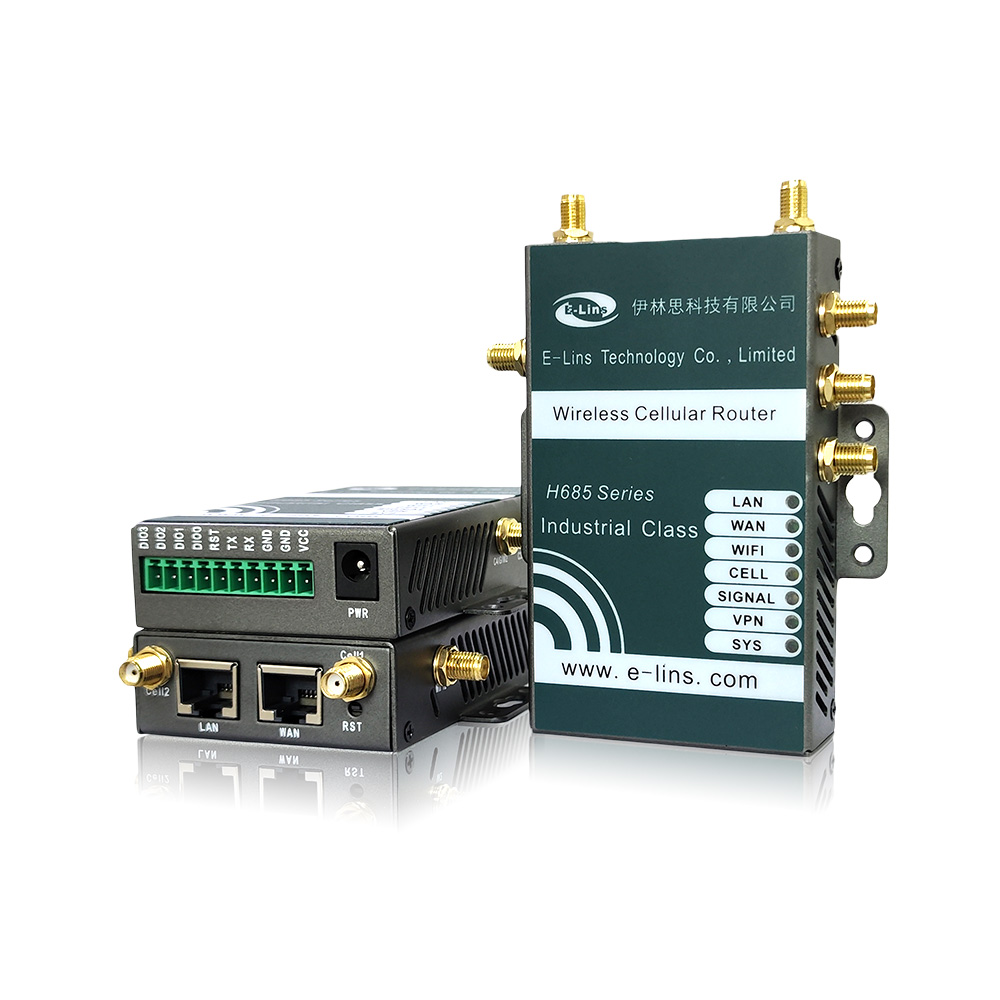
In a kiosk, a ceiling void, or a small enclosure without a mains socket, PoE In variants keep installation simple. The H685t-P1 is a compact PoE In router listing MQTT and DMVPN, while the H820t-P1 adds PoE In with WireGuard and MQTT.
4. A dual SIM site with PoE and field devices
Where a site combines a camera, a PLC, door contacts, and a requirement to stay online through an operator outage, the H900t family offers dual SIM primary and backup operation, Gigabit Ethernet, serial ports, four DI/DO, GPS/BeiDou and dual power inputs, with a PoE Out variant in the H900t-P2.
5. PoE inside an equipment maker’s product
For manufacturers building LTE into their own equipment, E-Lins embedded boards bring PoE onto the board itself. The H820-B combines 4G with five Fast Ethernet ports, RS232/RS485, and PoE In and Out, and the H685-B adds PoE In with four DI/DO and RS232 in a smaller format.
Set-up
E-Lins model
PoE role
Pole-mounted outdoor LTE
H820QOt
802.3af/at powered device
Cabinet router powering a camera
H820t-P2
Active PoE Out
Dual SIM with PoE Out
H900t-P2
PoE Out
Compact router powered by switch
H685t-P1, H820t-P1
PoE In
Embedded in equipment
H820-B, H685-B
PoE In and Out, or PoE In
What Rugged Means Beyond PoE
PoE is only one part of surviving outdoors. E-Lins specifies industrial-grade components rated from -35°C to +75°C, 15KV ESD protection, and 1.5KV electromagnetic isolation, with protection against transients, reverse polarity, over-current, and over-voltage. Most H-series routers use an IP30 alloy metal case designed to withstand vibration and shock, with desktop, wall, and DIN-rail mounting, while the H820QOt outdoor model is sealed to IP68. The H900t adds ISO 7637-2 compliance and ignition sensing for vehicles. Hardware watchdog timers and link self-healing recover the router automatically when a surge or brownout disrupts it.
Questions to Ask a Rugged 4G PoE Router Factory
Is the PoE port standards-based or passive, and at what voltage? What is the total PoE budget, and does it change at high temperature? Which surge protection is built into the Ethernet ports, and what external protection is recommended? Which PoE In and PoE Out variants exist for the same platform? Can the router be managed and monitored remotely, so a stuck camera or a failed link is noticed quickly? E-Lins routers support TR-069, SNMP, and SSH and work with the E-Lins NMS cloud platform.
The Factory Behind the Router
Shenzhen E-Lins Technology Co., Ltd. builds its routers in its own SMT factory and assembly lines in Shenzhen under ISO 9001 and ISO 14001, with a monthly capacity of tens of thousands of units. Its products carry CE, FCC, and UKCA certification and comply with RoHS, and its OEM and ODM services can involve interface layout, enclosure design, and firmware behaviour for projects that need a PoE design of their own. Choose a rugged 4G PoE router factory that understands the cable as well as the router, and outdoor PoE sites will stay powered and online.
https://e-lins.com/
Shenzhen E-Lins Technology Co., Ltd. -
AuthorPosts

- You must be logged in to reply to this topic.