- This topic is empty.
-
AuthorPosts
-
2026-01-12 at 2:50 pm #64186
In modern industrial production and quality control processes, metal detection technology plays a critical role. From food processing to pharmaceuticals, chemical manufacturing, plastic recycling, and packaging industries, metal detectors help identify and remove metal contaminants, ensuring consumer safety, enhancing production efficiency, and reducing costly equipment damage or product recalls. The two most common types of metal detection systems are vertical metal detectors and horizontal metal detection systems. In this article, we will provide a detailed comparison of these two systems, covering principles, applications, advantages and disadvantages, and practical selection guidance to help businesses make informed decisions.
1. Understanding Vertical and Horizontal Metal Detectors
1.1 Vertical Metal Detectors
Vertical metal detectors are specifically designed to detect metal contaminants in materials that fall vertically, such as powders, granules, or small packaged products moving in free fall. Unlike traditional systems installed on conveyor belts to detect products moving horizontally, vertical detectors are ideal for applications where materials move downward under gravity.
A vertical metal detector typically consists of a transmitter coil, a receiver coil, and a control system. When a product containing metal passes through the detector, it disrupts the magnetic field, and the receiver coil detects the signal. The control system then determines whether to trigger an alarm or activate a rejection mechanism. This design allows vertical detectors to handle challenging product forms that horizontal systems struggle with.
1.2 Horizontal Metal Detection Systems
Horizontal metal detection systems, also known as conveyor or tunnel detectors, are installed along a conveyor belt or processing line. Products move through a horizontal detection channel where metal contaminants are identified.
These systems often incorporate multi-frequency technology, digital signal processing, and advanced control software, which enhances sensitivity to various sizes of metal contaminants while reducing false rejects. Horizontal systems are widely used in the food, pharmaceutical, chemical, and packaging industries because they seamlessly integrate with automated production lines.
2. How They Work: A Technical Comparison
2.1 Vertical Metal Detectors
Vertical detectors operate on the principle of electromagnetic induction. As materials pass through the vertical detection zone, any metal within the product causes a disturbance in the magnetic field. The receiver coil senses this interference and transmits the signal to the control system, which evaluates the detection and triggers a response if necessary.
The vertical orientation ensures that products falling freely are exposed to the detection field in a consistent manner. This design is particularly effective for granular or powdered materials where horizontal detection may be inconsistent.
2.2 Horizontal Metal Detectors
Horizontal systems rely on a product moving along a conveyor belt within a horizontal detection tunnel. Metal contaminants disturb the magnetic field as products pass through the tunnel. Advanced horizontal systems use digital filtering, multi-frequency scanning, and automated sensitivity adjustments to detect small metal particles in various orientations.
However, detection accuracy can sometimes be affected by product alignment, moisture content, or conductive packaging materials. Despite these challenges, horizontal detectors are highly effective for packaged products or uniform items that move continuously along a conveyor.
3. Applications of Vertical and Horizontal Metal Detectors
3.1 Food Industry
-
Vertical Detectors: Ideal for powders, granules, and small items like spices, sugar, flour, coffee beans, or nuts. These products often do not move reliably on a horizontal conveyor, making vertical detection more efficient and accurate.
-
Horizontal Detectors: Best suited for packaged or bulk products that move continuously on a conveyor, such as boxes, cans, or sealed pouches. Horizontal systems easily integrate with automated rejection mechanisms and real-time quality monitoring.
3.2 Pharmaceutical Industry
-
Vertical Detectors: Essential for loose tablets, capsules, and powdered formulations. Free-falling materials are better detected vertically, minimizing the risk of missed metal contaminants.
-
Horizontal Detectors: Effective for inspecting finished, packaged pharmaceutical products like blister packs, bottles, and cartons. Horizontal detectors can record inspection data for regulatory compliance.
3.3 Other Industries
-
Plastic and Recycling: Vertical detectors efficiently screen shredded plastic or granulated materials to remove metal debris.
-
Gravity-Fed Processes: Vertical detectors are commonly used before material enters critical machinery to prevent damage and ensure product purity.
-
Continuous Production Lines: Horizontal detectors are ideal for packaging lines, conveyor-fed assembly processes, or palletized goods inspection.
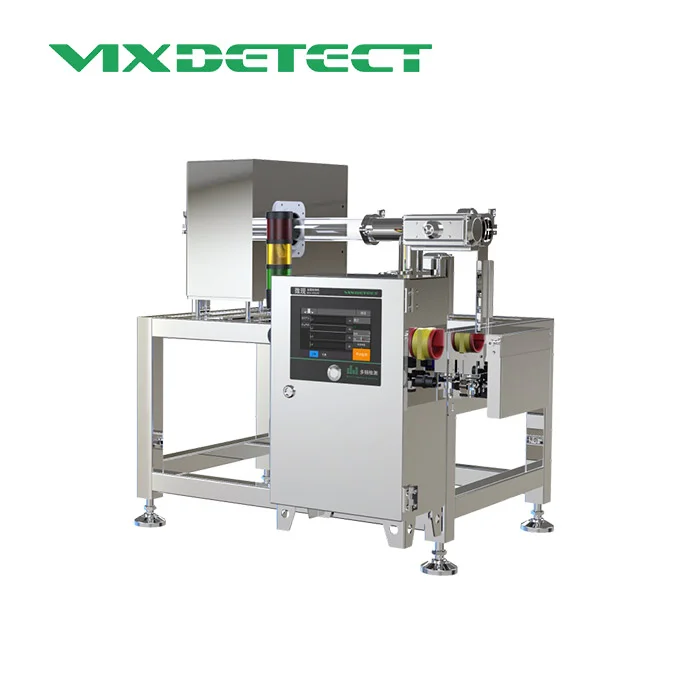
4. Advantages and Limitations
Feature Vertical Metal Detectors Horizontal Metal Detectors Product Form Best for powders, granules, and loose items Best for packaged products or items moving along a conveyor Detection Sensitivity High sensitivity to small metal particles Sensitive but may be affected by product orientation or packaging Installation Flexibility Can be installed at gravity-fed or drop points Usually requires conveyor integration Detection Reliability Less affected by product orientation Product orientation may affect detection, especially with irregular shapes Integration with Automation Standalone or semi-automated systems Easily integrates with conveyor systems, rejection units, and data recording Maintenance and Cost Specialized but cost-effective for specific products Standardized, widely available, easier to maintain Key Insight: Vertical detectors offer superior detection consistency for products that fall freely, while horizontal detectors excel in automated conveyor-based operations.
5. Choosing the Right System
Selecting the appropriate metal detection system depends on several factors:
5.1 Product Characteristics
-
Powders, granules, or loose items: Vertical metal detectors are preferred.
-
Packaged or bulk items moving on a conveyor: Horizontal detectors are more efficient.
5.2 Detection Requirements and Compliance
Industries with strict safety regulations, such as food or pharmaceuticals, often require detection of extremely small metal contaminants. Vertical detectors provide higher sensitivity in free-falling applications, while horizontal systems offer comprehensive monitoring for packaged products.
5.3 Automation and Integration
For highly automated production lines, horizontal systems offer seamless integration with PLCs, MES, and automated rejection devices. In some cases, combining vertical and horizontal detectors at different stages creates a dual-layer detection strategy, maximizing safety and quality assurance.
5.4 Cost Considerations
Vertical detectors are often more cost-effective for targeted applications like powder detection. Horizontal systems may have higher upfront costs due to conveyor integration but provide long-term operational efficiency, especially in large-scale, continuous production lines.
6. Summary
There is no universally “better” metal detection system—only the one best suited to the specific production scenario:
-
Vertical Metal Detectors: Ideal for powders, granules, and small free-falling products. Offer high sensitivity and consistent detection, particularly in gravity-fed processes.
-
Horizontal Metal Detectors: Best for packaged products or items moving along conveyor belts. Offer automation compatibility, data recording, and efficient integration with production lines.
In many advanced production facilities, the optimal solution is not to choose one over the other but to combine both systems. Vertical detectors can monitor critical raw material entry points, while horizontal detectors inspect finished products before shipment. This complementary approach ensures maximum protection against metal contamination and supports strict quality standards.
By understanding the strengths and limitations of both systems, manufacturers can design a metal detection strategy that ensures safety, maintains product quality, and improves operational efficiency.
http://www.vixdetect.net
vixdetect -
-
AuthorPosts

- You must be logged in to reply to this topic.