- This topic is empty.
-
AuthorPosts
-
2026-02-25 at 11:22 am #64418
In today’s stationery market, TPR erasers have become increasingly popular due to their clean erasing performance, durability, and environmentally friendly characteristics. However, when choosing between a soft TPR eraser and a hard TPR eraser, many buyers, distributors, and end users often ask the same question: Which one is better?
The answer depends on application, user preference, writing tools, and performance expectations. In this comprehensive guide, we will analyze the differences between soft and hard TPR erasers from material structure, erasing efficiency, durability, residue control, cost, and target markets. By the end of this article, you will clearly understand which type suits your needs best.
What Is a TPR Eraser?
TPR stands for Thermoplastic Rubber, a synthetic material that combines the elasticity of rubber with the processing advantages of plastic. Compared with traditional PVC or natural rubber erasers, TPR erasers offer:
-
Better flexibility
-
Lower odor
-
Latex-free composition
-
Smooth erasing performance
-
Reduced paper damage
-
Environmentally friendly production
Because of these advantages, TPR erasers are widely used in schools, offices, art studios, and promotional stationery markets.
However, TPR erasers are not all the same. They are typically classified into soft TPR erasers and hard TPR erasers, each designed for different performance priorities.
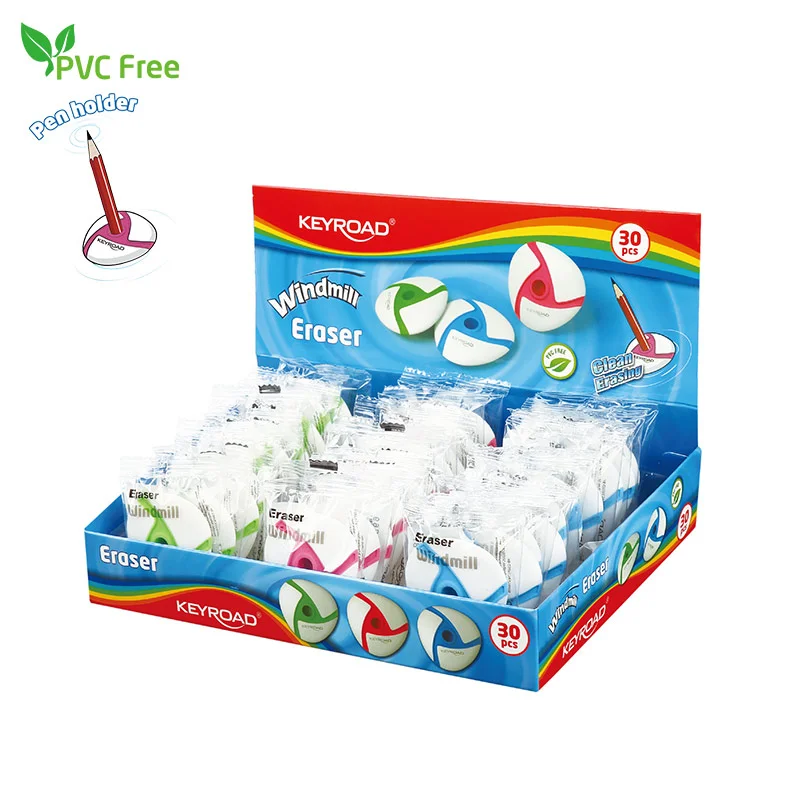
Understanding Soft TPR Erasers
1. Material Characteristics
Soft TPR erasers contain a higher elastomer ratio, giving them:
-
Greater flexibility
-
Higher friction coefficient
-
Better adaptability to paper texture
-
Softer touch feeling
When pressed, they deform slightly, increasing contact area with the paper surface.
2. Erasing Performance
Soft TPR erasers are excellent at:
-
Removing graphite cleanly
-
Handling HB, 2B, and softer pencils
-
Producing minimal residue
-
Preventing paper tearing
Because they conform closely to the paper surface, they lift graphite more gently and evenly.
3. Advantages of Soft TPR Erasers
-
Superior smudge-free performance
-
Less risk of damaging thin paper
-
Ideal for students and artists
-
Comfortable grip and user experience
-
Reduced noise during erasing
4. Disadvantages of Soft TPR Erasers
-
Wear out faster
-
Slightly higher material cost
-
Can become dirty more quickly
-
Less precise for fine technical corrections
Understanding Hard TPR Erasers
1. Material Characteristics
Hard TPR erasers contain a lower elastomer ratio and higher structural density. This results in:
-
Higher firmness
-
Lower deformation under pressure
-
Longer lifespan
-
Sharper edges
They maintain their shape better during long-term use.
2. Erasing Performance
Hard TPR erasers perform well in:
-
Removing firm graphite marks
-
Erasing technical drawings
-
Precise correction tasks
-
High-pressure writing marks
Because of their rigidity, they provide stronger mechanical friction.
3. Advantages of Hard TPR Erasers
-
Longer durability
-
Better for fine detail erasing
-
Cleaner edges for technical use
-
More cost-effective for bulk production
-
Less deformation over time
4. Disadvantages of Hard TPR Erasers
-
Slightly higher risk of paper abrasion
-
May leave more residue
-
Less comfortable for extended use
-
Not ideal for soft pencil grades (4B, 6B)
Soft vs Hard TPR Eraser: Performance Comparison
Below is a practical comparison across key factors:
Feature Soft TPR Eraser Hard TPR Eraser Flexibility High Medium Durability Medium High Residue Control Excellent Good Paper Protection Excellent Moderate Precision Moderate High Cost Slightly Higher More Economical Best for Students, Artists Engineers, Offices
Which One Is Better for Students?
For school use, especially among children and teenagers:
-
Soft TPR erasers are generally better
-
They reduce paper tearing
-
They work well with standard HB pencils
-
They are safer for frequent use
Students often erase repeatedly, and softer erasers minimize surface damage while maintaining a clean notebook appearance.
Which One Is Better for Artists?
Artists frequently use soft graphite such as 2B–6B pencils. For this reason:
-
Soft TPR erasers are usually preferred
-
They lift graphite smoothly
-
They create less smearing
-
They protect delicate sketch paper
However, for technical drafting or architectural drawing, a hard TPR eraser may provide better precision.
Which One Is Better for Office Use?
In office environments:
-
Hard TPR erasers offer better longevity
-
They maintain shape during frequent use
-
They are cost-efficient for bulk purchasing
For corporate stationery procurement, durability and price stability often outweigh ultra-soft performance.
Manufacturing Differences Between Soft and Hard TPR Erasers
The difference mainly lies in formulation and processing:
-
Elastomer Ratio – Higher ratio produces softer texture
-
Filler Content – Increased filler improves hardness and durability
-
Molding Temperature – Influences flexibility
-
Cooling Speed – Affects structural density
Manufacturers adjust these variables to achieve specific Shore hardness ratings.
Soft TPR erasers typically range from Shore A 30–50, while hard TPR erasers range from Shore A 60–80.
Environmental and Safety Considerations
Both soft and hard TPR erasers:
-
Are latex-free
-
Can meet EN71 and ASTM safety standards
-
Are recyclable
-
Produce less harmful odor than PVC erasers
However, high-quality soft TPR erasers often use premium-grade elastomers, making them slightly more environmentally friendly in low-toxicity applications.
Cost Comparison for Wholesale Buyers
From a B2B perspective:
-
Hard TPR erasers are more cost-efficient
-
They require less raw elastomer
-
They reduce production waste
-
They last longer in retail environments
Soft TPR erasers may command higher market prices due to better user experience.
Wholesale buyers targeting school supply brands may prefer soft variants, while promotional gift suppliers may choose hard versions for budget control.
Market Trends and Consumer Preferences
Current global trends show:
-
Growing demand for soft-touch stationery
-
Increasing focus on eco-friendly materials
-
Higher expectations for clean erasing performance
Premium markets in Europe and North America often prefer soft TPR erasers, while developing markets prioritize durability and price.
How to Choose the Right TPR Eraser
When deciding between soft and hard TPR erasers, consider:
1. Target User
-
Children → Soft
-
Engineers → Hard
-
Artists → Soft
-
Office staff → Hard
2. Pencil Grade
-
HB, 2B → Soft
-
H, 2H → Hard
3. Paper Type
-
Thin notebook paper → Soft
-
Thick drafting paper → Hard
4. Budget
-
Premium positioning → Soft
-
Mass market → Hard
Can One Be Universally Better?
There is no universally “better” option.
Soft TPR erasers excel in comfort, paper safety, and smudge control.
Hard TPR erasers dominate in durability, precision, and cost-effectiveness.
The better choice depends entirely on application and business positioning.
Final Verdict: Soft vs Hard TPR Eraser
If your priority is:
-
Clean performance
-
Paper protection
-
Premium user experience
Choose Soft TPR Eraser.
If your priority is:
-
Long lifespan
-
Precise correction
-
Bulk cost efficiency
Choose Hard TPR Eraser.
For manufacturers and distributors, offering both types allows you to cover wider market demand and meet different customer expectations.
Conclusion
The debate between soft and hard TPR erasers is not about superiority but suitability. Both types have clear advantages depending on the application, user group, and market strategy.
Understanding material composition, performance differences, and user needs is essential for making the right selection.
Whether you are a retailer, wholesaler, or private label brand, selecting the correct TPR eraser type can significantly enhance customer satisfaction and market competitiveness.
If you need further assistance selecting, customizing, or manufacturing high-quality TPR erasers, feel free to explore professional OEM solutions tailored to your market positioning.
http://www.johnshenstationery.com
johnshenstationery -
-
AuthorPosts

- You must be logged in to reply to this topic.